Home / Blog / Strength training
Can You Build Muscle After 40? Here's What the Research Actually Says.

By Zoe Schwartz, ACE Certified Personal Trainer and Behavior Change Specialist
· 4 min read
The short answer
Yes. Women can and do build muscle after 40, including well past menopause. What changes with age isn't whether it's possible. It's how much training volume it takes to get there.
The client stories on this site are real. Names and identifying details are changed to protect privacy.
Yes, but the honest answer has a "how," not just a "whether." Women can and do build muscle after 40, including well past menopause. What changes with age isn't whether it's possible. It's how much training volume it takes to get there, and that's a dial you can turn, not a door that closes.
The part of this that's real: muscle mass decline starts earlier than most people think
Sarcopenia, the medical term for age-related muscle loss, can begin as early as age 35. Left untrained, the typical rate is roughly 1 to 2 percent of muscle mass per year, accelerating to about 3 percent a year after 60. That decline is linked to higher risk for reduced metabolic rate and diminished functional strength as you age. This part isn't a myth.
What's also very real and encouraging: this effect is reversible and trainable well into advanced age. A systematic review and meta-analysis of resistance training in very elderly adults found a significant, measurable effect on muscle strength even in this population.
Where it actually gets more specific: menopause changes the equation
Here's the finding that surprised me most digging into the current research, and the piece most articles on this topic skip entirely: a 2023 controlled trial had pre-menopausal and post-menopausal women complete an identical 20-week resistance training program, twice a week, at either low or moderate intensity. The pre-menopausal women showed significant increases in fat-free mass, muscle mass, and muscle thickness. The post-menopausal women, at the same intensities and the same training frequency, showed none of those hypertrophy effects, regardless of whether they trained at low or moderate intensity.
The researchers' conclusion wasn't "post-menopausal women can't build muscle." It was that the volume these women were actually doing, roughly 6 to 8 sets per muscle group per week, wasn't enough to trigger hypertrophy post-menopause, even though that same volume worked fine pre-menopause. Something above that floor is likely required. Intensity wasn't the missing variable; training volume was.
That's a meaningfully different takeaway than simply "it gets harder after menopause," and it's the kind of nuance that gets lost when this question gets answered in a single soundbite.
What this actually means for a real training week
Here's where this gets concrete instead of abstract. Six to eight sets a week sounds like a lot until you realize how easily it gets absorbed by an ordinary program, and how easily it gets missed by a different one.
If you're training full-body three days a week, for example, hitting the same muscle groups each session, two to three sets per exercise per session already puts you right around that 6 to 8 range, meaning many post-menopausal women following a completely standard program are landing exactly on the floor that the research found insufficient, not comfortably above it.
If your three days are split by body part instead, each muscle group might only get trained once a week. In that structure, two to three sets on a single day doesn't come close to 6 to 8, regardless of how hard that one session is.
The fix looks different depending on which of those you're doing. In a full-body structure, it usually means adding a set or two per exercise, or one more targeted exercise somewhere in the week, to get reliably above the floor rather than sitting right on it. In a split structure, it more often means increasing frequency, training each muscle group twice a week instead of once, rather than piling more sets into a single already-long session.
What this means practically, depending on where you are
If you're pre-menopausal and in your 40s, a well-structured strength program at a moderate, sustainable frequency, two to three sessions a week, can produce real, visible hypertrophy within a matter of months, the same way it would at 30.
If you're post-menopausal, hitting a comparable result usually means restructuring for more total volume per muscle group per week, whether that comes from more sets, more frequency, or both. This isn't a reason to train harder in the sense of higher intensity or more punishing sessions. It's a programming detail, not a willpower problem.
This is also where working with a coach tends to matter most: knowing your hypertrophy stalled isn't the same as knowing why, and figuring out whether your specific program needs more sets or more frequency is a real programming decision, not a guess.
Either way, protein remains non-negotiable: current sports nutrition research puts the target for someone training to build or maintain muscle at roughly 1.4 to 2.0 grams per kilogram of bodyweight per day, spread across meals. That target doesn't change based on your menopause status. Only your body's ability to use that protein to build tissue does.
What that actually looked like for one client, post-menopause
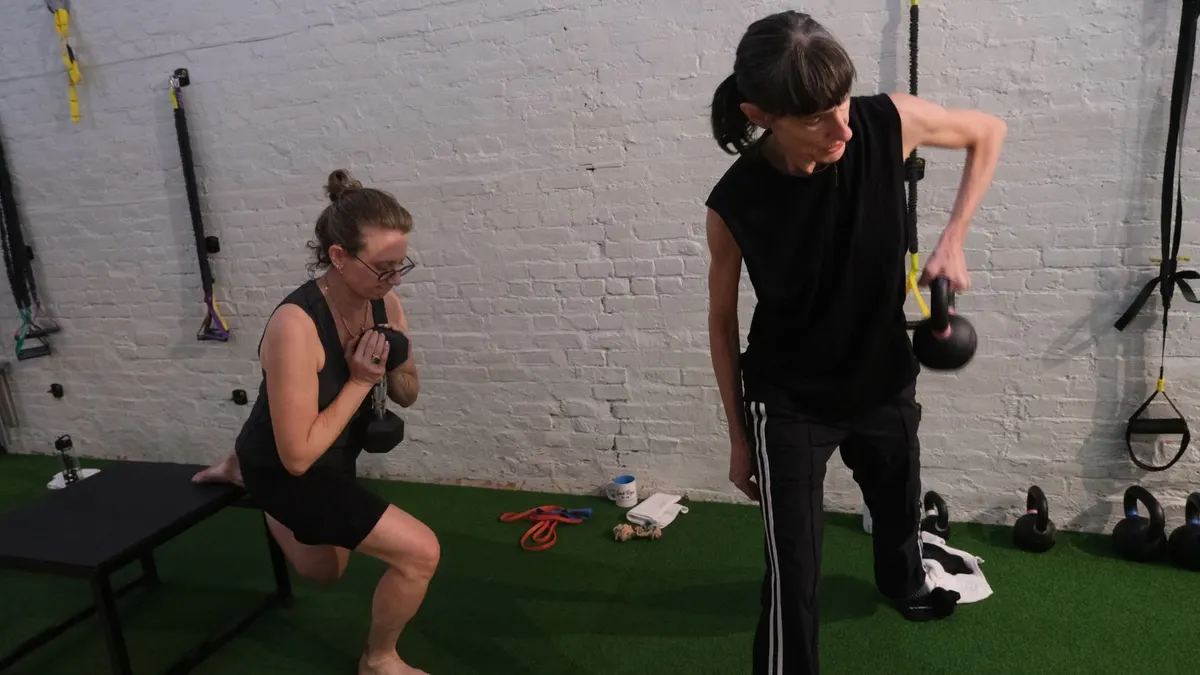
One client, a post-menopausal woman business owner in her 50s, started at 5-to-10-lb dumbbells and, over eight months of consistent progressive strength training, was lifting 20 to 45 pounds across different movements by the end. She didn't do that despite being post-menopausal. She did it because the program was built to account for it: consistency before intensity, then enough volume once the foundation was there.
The clients who get frustrated and conclude "it's just harder for me now" are almost always working with a program that wasn't adjusted for where they are, not a body that's stopped responding.
The bottom line
Can you build muscle after 40? Yes. After 50, after menopause? Also yes. The research is clear that the mechanism keeps working. What changes is the dose you need. You can still build real strength after 40.
If you want help figuring out what the right training volume looks like for where you actually are, that's exactly what a wellness strategy session is for.
Key takeaways
- Sarcopenia, the medical term for age-related muscle loss, can begin as early as age 35, and the effect is reversible and trainable well into advanced age.
- In a 2023 controlled trial, roughly 6 to 8 sets per muscle group per week wasn't enough to trigger hypertrophy post-menopause, even though that same volume worked fine pre-menopause.
- Intensity wasn't the missing variable; training volume was.
- Protein remains non-negotiable, and the target doesn't change based on your menopause status.
Quick answers
Can a woman build muscle after 40?
Yes. Women can and do build muscle after 40, including well past menopause. What changes with age isn't whether it's possible. It's how much training volume it takes to get there.
Can you build muscle after menopause?
Yes. If you're post-menopausal, hitting a comparable result usually means restructuring for more total volume per muscle group per week, whether that comes from more sets, more frequency, or both. It's a programming detail, not a willpower problem.
How many sets a week do I need to build muscle after menopause?
In a 2023 controlled trial, roughly 6 to 8 sets per muscle group per week wasn't enough to trigger hypertrophy post-menopause. Something above that floor is likely required.
Sources
- Harvard Health, "Age and muscle loss"
- "Effects of Resistance Training on Muscle Size and Strength in Very Elderly Adults: A Systematic Review and Meta-Analysis of Randomized Controlled Trials"
- "Resistance training alters body composition in middle-aged women depending on menopause — A 20-week control trial," BMC Women's Health, 2023;23(1):526
- ISSN Position Stand: Protein and Exercise — 1.4-2.0 g/kg/day recommendation
This post is general education from my coaching practice. It is not medical advice. Client stories are individual experiences, shared with care, and are not a guarantee of results.